Simple Shipping: Setting Your Own Shipping Prices
The setup in short
- Go to Dashboard → Settings → Shipping and pick Simple Shipping as the Shipping Method.
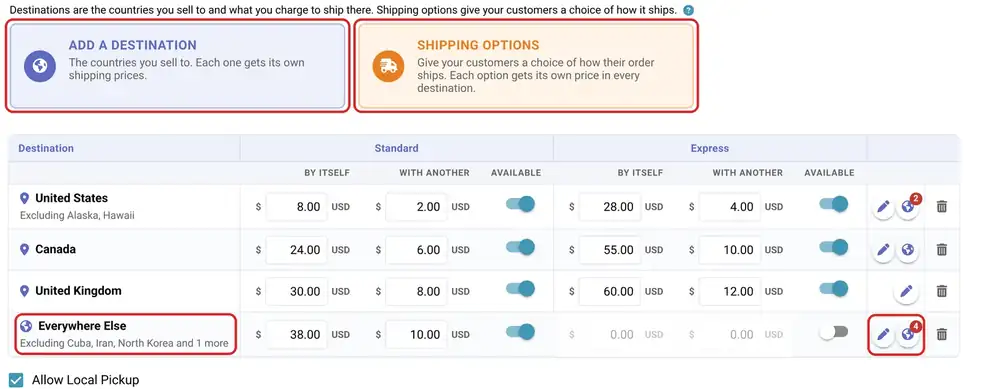
- Click Add a destination for each country (or state) you ship to. Each destination is one row in the table.
- On each row, type two prices: By itself, for the first item in the order, and With another, for each extra item.
- Add an Everywhere Else row only if you ship to the rest of the world. Use its globe to leave out places you do not ship to.
- Want Standard and Express? Click Shipping options to add an option, and each row gets a price for it. Switch Available off where an option does not apply.
- Tick Allow Local Pickup if customers can collect from you, then click Save Configuration.
Example: By itself $5.00, With another $1.50. One item ships for $5.00, three items for $8.00.
Simple Shipping lets you set your own shipping prices for each place you ship to. You decide exactly what a customer pays, based on where they live and how many items they buy. There is no carrier account to connect and nothing to weigh or measure. Simple Shipping is included on every plan.
Turning on Simple Shipping
- Go to Dashboard → Settings → Shipping. Shipping is in the IndieMade Settings menu at the top right of your Dashboard.
- At the top, choose One shipping method for all products, unless different products need different prices (see Different prices for different products below).
- Under Shipping Method, pick Simple Shipping. The Destinations table appears underneath.
The destinations table
Your prices live in one table, like a spreadsheet. Each row is a place you ship to. Each column is a price, so you can type straight down a column.
- Destination: the place the row is for. When you leave places out of a row, it says so underneath, for example Excluding Alaska, Hawaii.
- By itself: what shipping costs when this is the only item in the order.
- With another: what each extra item adds.
- Available: shown once you have more than one shipping option. Switch it off and that option is not offered in that row; its two prices turn grey.
- At the end of each row: the pen changes where the row ships, the globe picks places to leave out, and the trash can removes the row.
Every price is in your store currency, with the symbol in front and the currency code behind. Shipping is always charged in your store currency, even if your shop shows prices in more than one.
Adding a destination
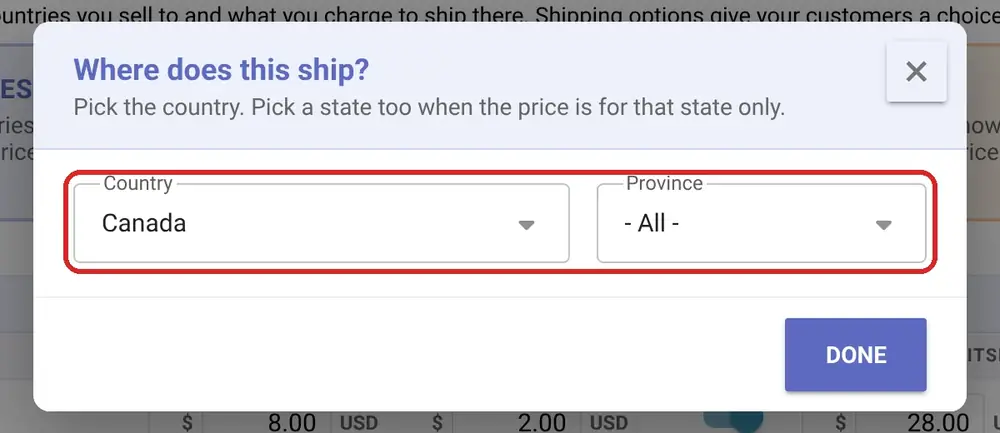
- Click Add a destination. A new row is added and the Where does this ship? box opens.
- Pick the Country. If the price is for one state or province only, pick it too; leave it on All for the whole country.
- Click Done.
- Type the By itself and With another prices on the new row.
- Repeat for each place you ship to, then click Save Configuration at the bottom of the page.
Besides countries and states, the Country list has a few special destinations:
- Everywhere Else: every country you have not given a row of its own. See below.
- European Union: every EU country at one price.
- RM Zone 1(Tracked) and RM Zone 2(Tracked): the Royal Mail international zones, for shops shipping from the UK.
- Northern Ireland: right under United Kingdom. Customers with a Northern Ireland postcode (starting BT) get this price whether they choose United Kingdom or Ireland as their country. Leave it out and those customers get your United Kingdom or Ireland price as before. If you do not ship to Northern Ireland at all, do not add this row: leave Northern Ireland out with the globe on your United Kingdom row instead (below).
Add only the countries you really sell to. A long list is hard to keep up to date and hard for customers to read.
Everywhere Else, and leaving places out
An Everywhere Else row covers every country that does not have a row of its own. Without one, customers can only check out to the places in your table. Add it only if you are happy to ship anywhere else in the world.
To ship almost everywhere but not to a few places, click the globe on the row. A box opens with every country the row covers, grouped by region, with a search box at the top. Tick a country and customers there get no shipping at checkout. Tick all and Clear work on one region at a time. Click Done, then Save Configuration. The globe shows how many places are left out, and the row lists them.
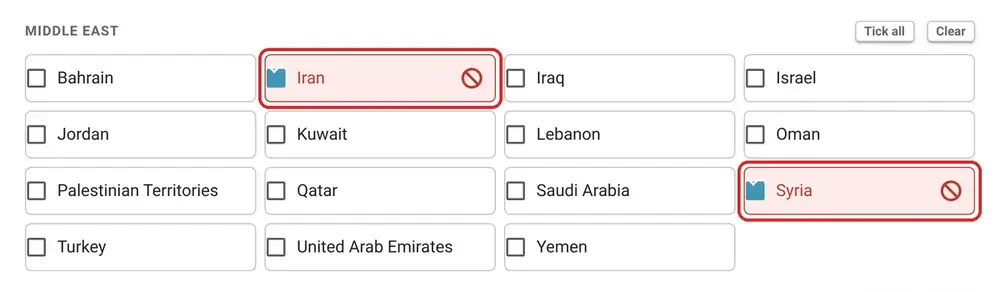
The globe works on other rows too:
- On a United States, Canada or Australia row for the whole country, it lists the states or provinces, so you can leave out Alaska and Hawaii, for example.
- On a United Kingdom row, it lists Northern Ireland, Highlands & Islands, Isle of Man, Jersey, Guernsey and Isles of Scilly, matched by the customer's postcode. See Leave out Northern Ireland or another part of the UK.
- On a European Union or RM Zone row, it lists the member countries.
- A row for a single state, or a country without states, has no globe.
Everywhere Else only lists places no other row covers. If you have a United States row, Alaska belongs to that row, so you leave it out there.
How By itself and With another add up
By itself is the box and postage for the first item. With another is what each extra item adds to the same parcel, usually less.
Example: By itself $5.00, With another $1.50.
- 1 item: $5.00
- 2 items: $5.00 + $1.50 = $6.50
- 3 items: $5.00 + $1.50 + $1.50 = $8.00
Set With another to 0.00 if more items do not cost you more to send. That suits small things like jewelry, cards and stickers. Set both prices to 0.00 for free shipping to that destination.
Offering Standard and Express (shipping options)
Shipping options give customers a choice of how their order ships, such as Standard or Express. Each option gets its own prices in every row.
- Click Save Configuration first, so nothing on the Shipping page is lost.
- Click the Shipping options card. The Shipping Options page opens in a new tab.
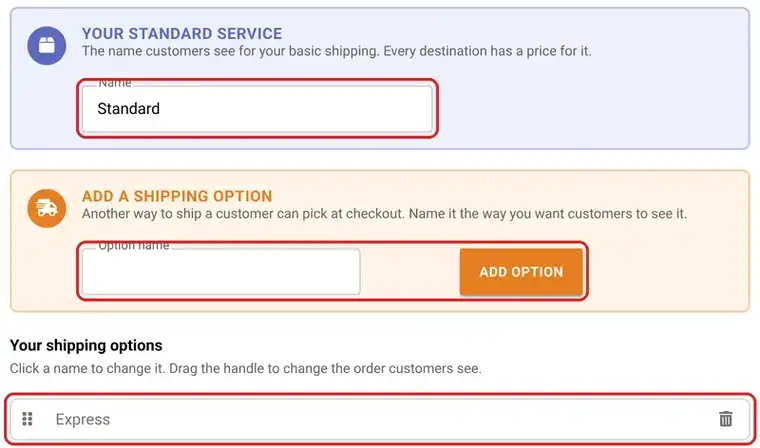
- Under Your standard service, the Name is what customers see for your basic shipping. It starts as Standard; change it if you like.
- Under Add a shipping option, type an Option name, such as Express, and click Add option. Name it the way customers should see it.
- Under Your shipping options, click a name to change it, drag the handle to change the order customers see, or click the trash can to remove one.
- Click Save Configuration.
- Back on the Shipping page, reload it. Each row now has By itself, With another and Available for the new option. Fill in its prices, switch Available off in rows where you do not offer it, and save.
Two things to know:
- An option name cannot be too close to one you already have. If you try to add Standard beside your standard service, the page tells you which name it collides with.
- An option left at 0.00 in a row where it is Available is offered free there. Fill in every price, or switch the option off.
What customers see at checkout
After a customer enters their address, checkout shows every option available for that destination with its price for their order. They pick one. If you allow local pickup, it is listed too, at no charge.
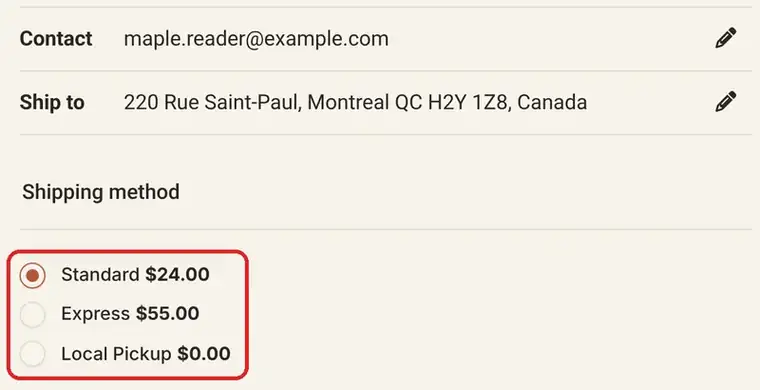
Local pickup
Tick Allow Local Pickup under the table to add a free Local Pickup choice at checkout. It is offered to every customer you ship to, wherever they are, so say on your shipping page where and when orders can be collected.
Rate label and Rate description
You can leave these two boxes above the table alone. The name customers see for your basic shipping is the Name of your standard service on the Shipping Options page. Rate label is only used if that name is ever empty, and Rate description is not shown to customers with Simple Shipping.
Different prices for different products
A ring and a large vase do not cost the same to ship. For that, give products their own shipping profiles instead of adding shipping options:
- Shipping options (Standard, Express) are a choice the customer makes at checkout.
- Shipping profiles are different price tables for different products. The customer never sees them; they just get the right price.
On the Shipping page, choose Choose a shipping method per product, then use Add Shipping Method to make a Simple Shipping profile for each kind of product, such as Small items and Large items, and pick the profile on each product. See Shipping Profiles.
When one order holds products from different profiles, the customer is never charged two By itself prices. The profile with the highest By itself price charges it once, and every other item adds only its own profile's With another price.
Example: Small items is $4.00 by itself, $1.00 with another. Large items is $15.00 by itself, $5.00 with another. A ring and a vase ship for $15.00 + $1.00 = $16.00.
A shipping option switched off for a destination in any of the order's profiles is not offered for that order. If you delete a profile that products still use, IndieMade asks which profile to move them to first.
Showing your prices on product pages
To show a small table of your shipping prices on each product page, open any product page while signed in, click the Settings gear in the bottom toolbar and, under Shipping Display, tick Show a shipping costs table on product pages. It lists each destination with its price on its own and with other items.
Weight and size for Google
Simple Shipping does not need product weights, so products have no weight fields unless you send them to Google. If Google Merchant Center asks for a shipping weight, see Package weight and size for Google. Those fields stay optional with Simple Shipping.
Tips
- Free shipping over a set order total is easier with a promotion than with 0.00 prices. See Promotions.
- Test your prices: add two or three products to your cart and go as far as the shipping step of checkout with an address in each place you ship to.
- Shipping methods give customers a price; they do not buy postage. You buy labels from your carrier or a label service.
Questions? Email support@indiemade.com.